I once wrote a book entitled "Voyaging on a Small Income" and the parts about provisioning and cooking proved very popular. "The Voyaging Vegetarian" would have followed, but so few people were then vegetarians that I thought no-one would publish it. Now many more people realise that eating dead animals is unkind and bad for the planet. I hope a blog, which I can update with new recipes, will work better than a book for liveaboards and aspiring voyagers, and those living simply in small spaces.
Back in the 80s, I wrote a book called "Voyaging on a Small Income", which was published and sold astonishingly well. It’s become almost a “classic” and is probably why you’ve found this site!
I’ve been living aboard and sailing since the 70s. Nine different boats have been home, sometimes for several months, sometimes for many years. I love the way of life, the small footprint and being close to Nature. I’m a great fan of junk rig and having extensive experience with both gaff and bermudian rig, I wouldn’t have any other sail on my boat. It’s ideal as a voyaging rig, but also perfect for the coastal sailing that I now do. I’d rather stay in New Zealand, not having to keep saying goodbye to friends, than go voyaging, these days.
Between 2015 and 2021, I built the 26ft "FanShi", the boat I now call home. For the last 45 years or so, my diet of choice has been vegetarian and is now almost vegan. I love cooking and particularly enjoy having only myself to please. I am combining all these interests (apart, perhaps, from junk rig!) in this blog. I hope you enjoy it. I also have other blogs: www.anniehill.blogspot.com and http://fanshiwanderingandwondering.wordpress.com
I love spinach and there are many ways
to cook it. This is as very simple recipe and if you are one of these
terribly organised people, you can even cook the rice well in
advance, in which case it will go together very quickly. It isn't really a casserole, but that's the nearest I could get to describing it.
There’s no real point in specifying a
weight of spinach – you tend to get what you’re given and take
it. Suffice it to say that there has to be enough to feed two people.
If you’re unused to cooking spinach, be warned: a big bunch that
will hardly stuff into the shopping bag becomes only a few cupfuls
when it’s cooked.
The base of this recipe, one of Rose Elliot's, was taken from a French dish, cooked in a tian, which is a shallow, pottery or terracotta dish. It's not one I make very often, because it uses eggs and I try not to eat too many of those. However, it is very good, nutritious and not too filling, and also looks very attractive. The original calls for breadcrumbs, but wherever I can, I use sesame seeds instead, which saves the business of grating crumbs, and they are far, far tastier! If you have neither an oven, nor a tian, I suggest making it in the frying pan.
Serves 2
Ingredients
1/2 cup brown rice
1 cup salted water
2 tbsp sesame seeds
bunch of spinach
1 tbsp olive oil
2 garlic cloves
1/2 cup grated cheese*
2 eggs
nutmeg
cracked black pepper
Method:
Cook the rice in salted water in the usual fashion.
In a small, dry, frying pan, toast the sesame seeds, until they are lightly browned. Be careful - they can burn very easily and become bitter. Set aside.
Wash the spinach and then roughly
chop it.
Heat the olive oil in a large frying pan, add the spinach and
cook it for about 3 minutes. Keep it moving so that it gets coated
in oil and the stuff at the top of the pan can cook, too.
Lower the heat and insert a flame
tamer, if necessary. Add the cooked rice, diced garlic and the grated cheese. Mix
well.
Beat the eggs. and stir in with the
other ingredients. Season generously with nutmeg, salt and pepper.
Smooth the top over and sprinkle with the sesame seeds.
Cover and
cook over a low heat for 15 minutes. Take off the cooker and leave
to stand for 3 or 4 minutes before serving, just in case it has
‘caught’.
Some lightly cooked carrots go well
with this.
Note:
If
you have an oven, finish it off in there, once you've mixed everything
together and added the sesame seeds. That way you will brown it; however it may be wise to put the toasted sesame seeds on top, just before serving.
*If you eat eggs, but don't eat dairy products, use vegan cheese or mix 2 tbsp nutritional yeast in with the eggs.
Although I have a recipe under Basic White Sauce, I thought that as cheese sauce is so much used and
loved, maybe it should have its own post.
I have two versions here: classic
cheese sauce and vegan cheese sauce. Actually, it isn’t really a
classic cheese sauce, because I suggest use cornflour instead of
plain flour, because I don’t think most people can be bothered to
make a roux, which involves very gently flying flour in butter and
then gradually adding infused milk, stirring all the time, until the
sauce is cooked. It takes quite a long time for white flour to alter
its personality and you need to carry on stirring, or put the sauce
under an incredibly low heat until you get your perfectly cooked
white sauce. You can, of course, mix and match the recipes to suit
your tastes.
If you have any choice, try to use a
sharp, yellow cheese, such as (real) Cheddar, Double Gloucester or
Red Leicester for a fuller flavour and a more attractive appearance.
I am sure there are plenty of good vegan cheeses being made on this
planet, but if they exist in New Zealand, they are unavailable
outside the big cities. I therefore suggest nutritional yeast in the
vegan version: the advantage of using gram flour, is that it makes
the sauce a pretty pale yellow colour.
I say this serves two, but of course it
depends what you’re doing with it: my assumption is that you are
pouring it over something life stuffed pancakes. I make suggestions
for using the recipe for lasagne
in the variations.
Serves
2
Ingredients
2
tbsp cornflour
1
cup milk
1
cup grated cheese
a
good shake of *Worcestershire Sauce OR 1 tsp Dijon mustard
salt
and pepper
Method:
Put
the cornflour into a small saucepan and add about a quarter
of the milk. Stir well until the mix is smooth. Add the rest
of the milk.
Put
the pan over a moderate heat and start to cook, stirring
constantly. If you leave it even for a moment, once it starts to
thicken, it will form lumps that are just about impossible to get
rid of.
Reduce
the heat, add the cheese, Worcestershire sauce or mustard
and season with salt and pepper.
Use
immediately.
Vegan
cheese sauce
Ingredients
1
tbsp gram flour
1
cup plant milk/water
1
tbsp nutritional yeast
1
tsp Dijon mustard
salt
and pepper
Method:
Put
the gram flour into a small saucepan and add about a quarter
of the milk. Stir well until the mix is smooth. This will
take some time and you may prefer to use a whisk. You don't want to
start cooking until you've got rid of all the lumps. Add the rest of
the milk.
Put
the pan over a moderate heat and start to cook, stirring constantly.
As the sauce starts to thicken lower the heat and stir vigorously.
It will start to form alarming lumps, but if you keep stirring they
will disappear.
When
the sauce is smooth, reduce the heat again and add the nutritional
yeast and mustard and season with salt and pepper.
Use
immediately.
Notes:
*
I
ought to mention that Worcestershire sauce, at least the original
and peerless product made by Lea & Perrin's, contains a very
small amount of anchovies. Considering that you merely shake a few
drops into the sauce, the amount of anchovies must be about
homoeopathic, but if you take your vegetarian principles seriously,
I suppose you should avoid it. Sadly, I have found all the
alternative brands to be significantly inferior.
I find the gram flour is
sufficiently creamy that I don't need to add plant milk. However,
you may well prefer the taste.
You
can, of course, use gram flour in the first recipe, instead
of cornflour.
If
you are trying for an elegant result, use white pepper
instead of black, to avoid little black flecks in the sauce.
If
you have any freshherbs, chop them and sprinkle over the top.
To use the sauce in a flan
or lasagne, I
suggest making more and making it thicker. So double
the amount of flour
and use one and a half times
the liquid.
This
is definitely a special-occasion soup, calling as it does for mixed
mushrooms and French bread. No prizes for guessing that I love
mushrooms! Try finding ceps and oyster mushrooms Even if you can’t
find anything particularly exotic, this is still a delicious soup,
served in an attractive manner.
Use
1/3 seawater to 2/3 fresh, if the sea is clean, and leave out the
salt.
Serves
4
Ingredients
2
tbsp olive oil 1
onion 6
cups mixed mushrooms 1¼
cups milk 3¾
cups water 8
slices rustic or French bread 3
tbsp butter 2
garlic cloves 3/4
cup finely grated cheese preferably Swiss
(See notes)
salt
and pepper
Method:
Heat
the oil in a large saucepan and cook the chopped onion for a few
minutes until softened.
Roughly
chop the mushrooms.
Add
them to the pan, stirring so that they’re all covered with oil.
Add
the milk and bring to the boil. Lower the heat, cover and simmer for
about 5 mins.
Stir
in the water and bring up to simmering point.
Toast
the bread.
Mix
the garlic and butter together and spread on the toast.
Put
two pieces of toast in the bottom of each bowl and pour the hot soup
over.
Top
with the grated cheese and serve at once.
Notes:
I
can give no suggestions for a vegan equivalent of Swiss cheese,
unless you happen to be in a very large town, or somewhere
sufficiently cosmopolitan to have a wide range of good, vegan
cheeses. This is very unlikely, I’m afraid.
I
invented this on the spur of the moment one evening in Trinidad. We
had invited some friends round for drinks and I wanted fairly
substantial nibbles, so that no-one would need to cook more than a
light meal after they left. I had a ripe avocado on board, but none
of the other ingredients for Guacamole, which would have been my
normal choice. However, this recipe worked so well that I reckoned
it was worth adding to the repertoire!
Serves 4 for a
starter
1
large, ripe avocado pear
at
least 1/2 cup finely grated cheese
1/4
tsp of hot sauce
1
tbsp lime juice
salt
and pepper
Method:
Cut
the avocado pear in two, remove the stone and scoop out the flesh into a
bowl.
Add the grated cheese. A 1/2 cup is sufficient if the cheese
is full-flavoured; add more if it’s very mild.
Blend the avocado
and cheese together with a broad-bladed knife, and add the hot sauce
– use less if you don’t like your food too spicy.
Blend in the
lime juice and season the mixture. The result should be a soft pâté,
almost like a dip.
This
is another recipe capable of many variations. If you make it a
little thinner, it becomes a lovely dip, excellent with raw
vegetables. It can be made with any cheese that has a full flavour,
but would be very bland made with something like mozzarella. You do
need a fine grater for the cheese to blend properly.
Serves 4 as a starter
1
cup finely grated cheese
2
tbsp yoghurt
salt and pepper
Method:
Grate
the cheese into a bowl. Mix in the yoghurt and season with
black pepper.
Taste the pâté and add salt if you think it needs it.
Variations:
Use
soft butter or mayonnaise instead of the yoghurt.
Add 2
tbsp Dijon mustard to the pâté.
Add 1/4 cup wine to
make a dip; reduce the amount of yoghurt if you want it to stay as a
pâté.
I no longer eat butter and dislike margarine, so if I want to make a
toasted sandwich these days, I tend to fry it in a minimum of olive oil.
However, so far I've been unable to find edible vegan cheese in New
Zealand, so, sadly, toasted cheese
sandwiches now exist only in my memory.
I'm still looking for a
successful vegan "Cheddar cheese" recipe. All suggestions gratefully
received.
Makes one
2
slices bread
butter
Cheddar
cheese or similar
Butter
the bread generously.
Slice the cheese and fit it to the bread –
don’t make the sandwich too lumpy or it will be difficult to toast
and don’t let the cheese overlap the crusts because it will drip
onto the toaster and start to burn.(This is much less of an issue if you 'toast' it in the frying pan)
Put the toaster over a medium
flame and carefully place the sandwich on it. Don’t use too high a
flame or the bread will toast before the cheese has started to melt.
Depending on the size of both your bread and the flame, you may have to
move it around to toast evenly.
When one side is done turn it over
and toast the other side.
Variations:
Cheese
and mustard: make as
above, substituting Dijon or your preferred mustard for the butter.
If you don’t watch calories, you can use butter and spread the
mustard on the cheese.
Cheese
and onion: add thin
slices of onion with the cheese.
Fried
egg sandwiches are good at any
time of the day, although this isn’t strictly a toasted
sandwich.
Peanutbutter
is good, and even better with a couple of slices of tomato. Beware that the tomato can get extremely hot.
Make them
with banana
skin bacon. Toast the bread on
one side only and if you’re feeling particularly decadent, dip the
untoasted side in the cooking oil before assembling the
sandwich.
Any
bean
or nut spread
will go well on a toasty. This can also get extremely hot.
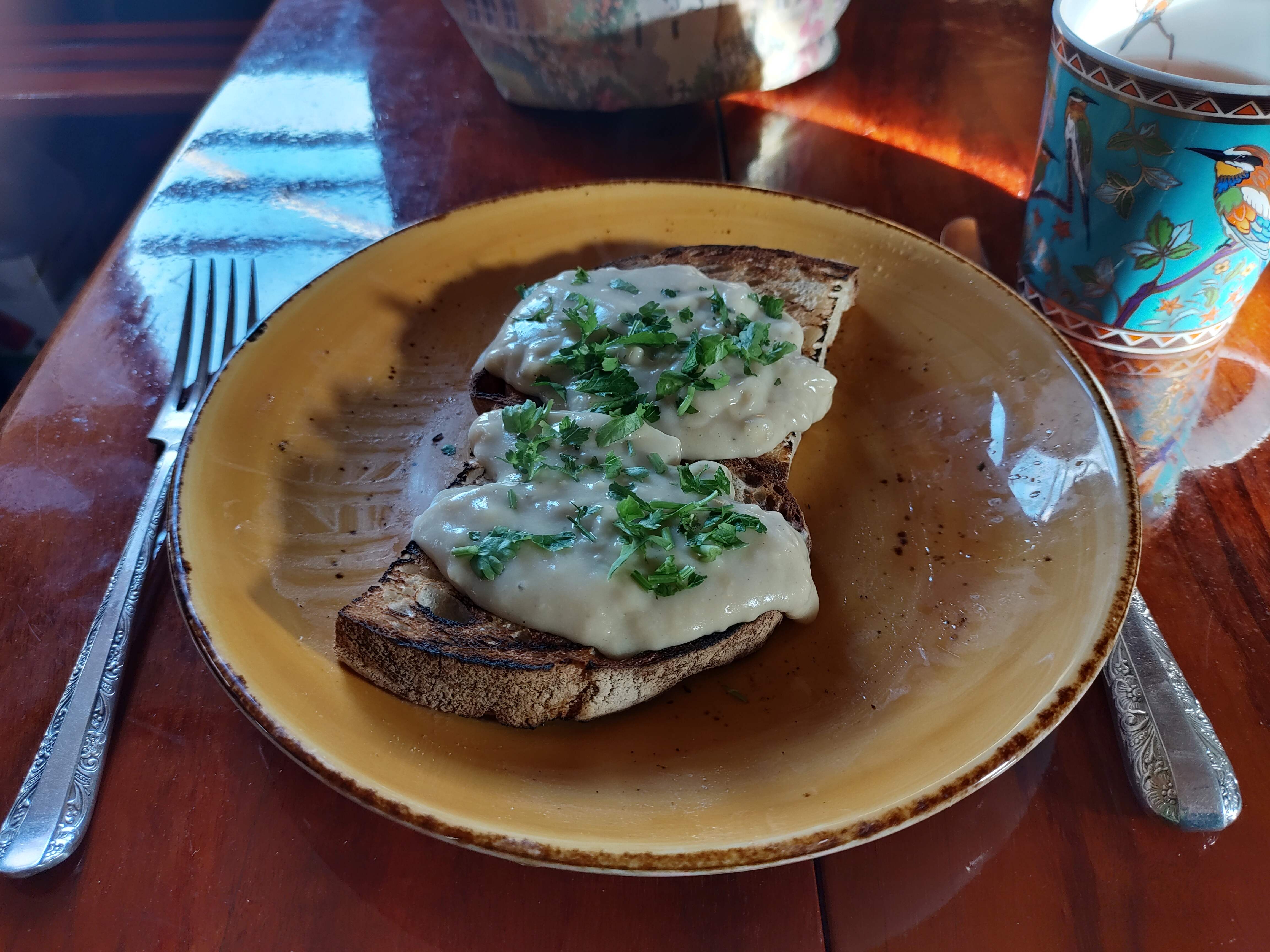
This is sometimes known as Welsh Rabbit, but I can assure you that it is definitely a vegetarian meal. Equally, as far as I know, it has nothing to do with Wales. Vegans can use the
variation below, or follow this recipe substituting grated vegan cheese.
I ought to mention that Worcestershire sauce, at least the original and peerless product made by Lea & Perrin's, contains a very small amount of anchovies. Considering that you merely shake a few drops into the rarebit, the amount of anchovies must be about homoeopathic, but there we are. Since I've live alone, I've been strictly vegetarian and Lea & Perrin's Worcestershire sauce is one of the pleasures of life I have had to forego. Sadly, all the other brands I've tried are a travesty and not worth their space on board. You may be more fortunate.
Welsh rarebit is
a favourite in England for lunch or a light dinner. It also makes a good breakfast. If you have any choice, try to use a sharp, yellow cheese, such as (real) Cheddar, Double Gloucester or Red Leicester for a fuller flavour and a more attractive appearance. The advantage of using gram flour, in the vegan version, is that it makes the sauce a pale yellow colour.
Serves 2
Ingredients
2
tbsp cornflour
1
cup (plant) milk
1
cup grated cheese
a good shake of Worcestershire Sauce OR 1 tsp Dijon mustard
salt
and pepper
2
– 4 slices of bread
Method:
Put the cornflour into a small saucepan and add about a quarter of the milk. Stir well until the mix is smooth. Add the rest of the milk.
Put the pan over a moderate heat and start to cook, stirring constantly. If you leave it even for a moment, once it starts to thicken, it will form lumps that are just about impossible to get rid of.
Reduce the heat, add the cheese, Worcestershire
sauce or mustard and season with salt and pepper.
Keep the sauce warm while you toast the bread.
Put the toast onto warmed plates, pour some
sauce over each slice and eat immediately.
Vegan version
Ingredients
1 tbsp gram flour
1
cup plant milk/water
1 tbsp nutritional yeast
1 tsp Dijon mustard
salt
and pepper
2
– 4 slices of bread
Method:
Put the gram flour into a small saucepan and add about a quarter of the milk. Stir well until the mix is smooth. This will take some time and you may prefer to use a whisk. You don't want to start cooking until you've got rid of all the lumps. Add the rest of the milk.
Put the pan over a moderate heat and start to cook, stirring constantly. As the sauce starts to thicken lower the heat and stir vigorously. It will start to form alarming lumps, but if you keep stirring they will disappear.
When the sauce is smooth, reduce the heat again and add the nutritional yeast and mustard and season with salt and pepper.
Keep the sauce warm while you toast the bread.
Put the toast onto warmed plates, pour some
sauce over each slice and eat immediately.
Notes:
I find the gram flour is sufficiently creamy that I don't need to add plant milk. However, you may well prefer the taste.
You can, of course, use gram flour in the first recipe, instead of cornflour.
The best bread for toasting is either home-made or a decent 'artisan' bread such as sourdough. If you use Chorleywood bread, the toast will turn into a soggy mess. I know that sometimes you haven't been able to make bread, and that really good bread just simply isn't available, but you have been warned!
If you are trying for an elegant result, use white pepper instead of black, to avoid little black flecks in the sauce.
If you have any fresh herbs, chop them and sprinkle over the top.
The
following is a lovely, crusty bread recipe, which tastes delicious
and goes very well with soup or salad. I suggest making a smaller
loaf than usual – ‘1 lb’ – because you will probably eat most
of it at one sitting, although the fat from the cheese means that the
loaf should keep well.
If
you’ve never made bread before, please read the recipe for Basic Bread, before making this one. If you don’t have an oven,
follow the directions for The Perfect Ovenless Loaf.
2
cups wholewheat flour
2
tbsp vital wheat gluten
½
tsp salt
1
tsp instant dried yeast
2
tbsp olive oil
½
tsp honey/sugar
1
cup lukewarm water
¾
cup grated cheese
Put
half the flour and the vwg) into a large bowl. Add the salt, dried
yeast (sweetener) and olive oil. Stir in the water. Mix them
together into a smooth batter.
Add
the cheese.
Gradually
add the rest of the flour and knead the dough for a few minutes.
Roll it into a sausage and put this into a well-greased (or oiled)
‘1 lb’ loaf tin. Flatten it down and cover.
Leave
the bread to rise until it’s about 25 mm (1 inch) above the sides
of the tin.
When
your loaf is ready to cook, light the oven and cook it at a Moderate
heat for about 30 minutes.
To
enjoy this loaf’s flavour at its best, eat it warm.
Variations:
Use
seawater instead of fresh water and salt.
If
you have an oven, you can also use this dough to make up to 8
individual rolls.
This
is a very lazy, and very effective way of making a thick sauce to go
over pancakes, lasagne and so on. In my opinion it tastes much better than white sauce, however carefully made. I would be a little bit careful
using it in the pressure cooker, however, because it might separate.
If you make your own yoghurt (see recipe), you will usually have some
on board. This recipe assumes that you have thick, Greek-style
yoghurt, but if yours is on the thin side, use all yoghurt or add
another egg.
Serves 2
1/2
cup Greek-style yoghurt
1/2
cup milk
1
egg
1
cup grated cheese
Method:
Beat
the yoghurt, milk and egg together. Add the grated cheese and mix
well.
Pour
over the dish and heat through, either on a low heat with a flame
tamer on the top of the cooker, or in a moderate oven.
Note:
If you are making this sauce for lasagne, there's no need to cook it first.
This is also a brilliant sauce for making "quiche". Just pour it over after you've put the other ingredients in the flan case.
Variations
You could, of course, use vegan yoghurt, plant milk and vegan cheese or 1 tbsp nutritional yeast if you don't like using dairy products. I can understand that choice because personally, I find it a lot easier to eat the odd egg than to support the dairy industry.
I
haven’t tried making a fully vegan version of this, because the usual egg substitute
is 1 tbsp ground flax seed
whisked in to 3 tbsp water and then let stand until it becomes gelatinous,
about 5 minutes. This works well in baking, but I’m not sure if it
would achieve the desired result in this recipe; and it would also colour the sauce. Maybe a commercial egg substitute would work, but I'm wary of ultraprocessed food. Moreover, most of them appear to be based around gram flour which (a) I already have on board and (b) is not an egg substitute: eggs are eggs, flour is flour.
For many years, I lived with a man who detested cheese and because money was in short supply, I hardly ever bought this treat for myself. I missed it, but its lack was tolerable, although I really enjoyed eating it when I had a chance. Then I lived with someone who loved cheese and, moreover, we had a little more money, so we generally had it on board.
When I decided to live on my own in New Zealand, I could finally eat exactly how I wanted to. However, my budget was again pretty limited and I found that New Zealand, in spite of being awash in dairy cows, has no tradition of its own cheese. Most of the affordable cheese made here, is a pastiche of Camembert or Brie, of Gouda and Edam and of course, the ubiquitous so-called Cheddar. I had hoped for so much more, remembering the open markets of my English youth, where I could buy several different versions of my local cheese. While there is some superb artisan cheese in this country, not only is most of it beyond my financial means, but most of it is beyond my physical means, only being sold in the major cities. Over recent years, the plight of dairy cattle (particularly calves) and of the planet overall, has inexorably inched me towards veganism. However, I still succumbed to the lure of Parmesan or Pecorino cheese. It was a very happy day, therefore, that I stumbled across a vegan alternative on the Internet.
Not only is vegan "Parmesan" a genuinely acceptable alternative to the real thing, it even emulates it sufficiently accurately, that friends have tipped generous amounts of the food I've served them, without even noticing that it's not the 'real thing'. Often what you taste is what you expect!
Many people use cashew nuts: I prefer Brazil nuts. (In this blog I am not generally going to discuss the various ethical pros and cons of one nut/grain/legume over another. Suffice it to say that the worst of them is probably less unethical than most animal products.) You will need a blender or good mouli-grinder to make this.
Brazil nuts are one of those that tend to go stale quite quickly - like walnuts - so I have assumed that the 'cheese' would also lose its flavour and freshness quickly. I therefore limit its production to about 1/3 cup at a time. The recipe is so simple that it's extremely easy to make larger quantities. However, I do find that a small jar will keep happily for at least two or three weeks without refrigeration, which is another of its great virtues.
Makes about 1/3 cup
Ingredients
1/4 cup Brazil nuts
1 tbsp nutritional yeast
1/4 to 1/2 tsp salt
Method:
Roughly chop the Brazil nuts into about 1cm pieces
Put the chopped nuts, the nutritional yeastand the salt into your blender or mouli and process until you get the consistency of finely grated cheese.
Serve over pasta, etc, as you would Parmesan cheese.